Dhliz rating



About
Date and place of birth:
27/05/1931
- Cairo, Egypt
Date and place of death:
17/01/2015
- Cairo, Egypt
(83 years)
Years active:*
1940 - 1993
Spouses:
Ezzel Dine Zulfikar
-
Muhammad Abdel-Wahab Mahmoud
Children:
Nadia Thol-Faqqar
-
Tareq Omar Sharif
Relatives:
* According to Dhliz film database
More information
About the Artist
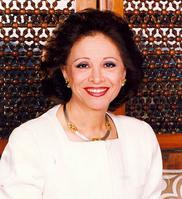
- Name: Faten Ahmed Hamama
- Born: 27 May 1931, Egypt (raised in Cairo)
- Died: 17 January 2015, Cairo, Egypt
Family and Early Life
- She came from a middle-class Egyptian family.
- She had two children: Nadia and Tarek.
Education and Beginnings
- As a child, her early appearances in cinema drew wide attention, making her one of the most prominent rising stars from the 1940s onward.
- She briefly attended the Higher Institute of Theatrical Arts in Cairo while launching her professional career.
Career and Notable Works
-
Known as “The Lady of the Arab Screen,” an honorific celebrating her artistic excellence and long-lasting influence across decades.
-
Selected films:
- Struggle in the Valley (Sira' fi al-Wadi, 1954) — also known as The Blazing Sun
- I Do Not Sleep (La Anam, 1957)
- Lady of the Palace (Sayyidat al-Qasr, 1958)
- Among the Ruins (Bayn al-Atlal, 1959)
- The Nightingale’s Prayer (Du'a' al-Karawan, 1959)
- River of Love (Nahr al-Hubb, 1961)
- The Open Door (al-Bab al-Maftuh, 1963)
- The Thin Thread (al-Khayt al-Rafee'’, 1971)
- Empire M (Imbratoriyat Meem, 1972) — “Meem” is the Arabic letter M
- I Want a Solution (Ureed Hallan, 1975)
- Mouths and Rabbits (Afwah wa Aranib, 1977)
- The Night of Fatma’s Arrest (Laylat al-Qabd 'ala Fatma, 1984)
-
Land of Dreams (Ard al-Ahlam, 1993) — her final feature film
-
Television dramas:
- The Conscience of Abla Hikmat (Damir Abla Hikmat, 1991) — “Abla” is a respectful title often used for a female teacher
- Face of the Moon (Wajh al-Qamar, 2000) — her final TV role
Awards and Honors
- Named “Star of the Century” by the Egyptian Film Writers and Critics Association at the Alexandria Film Festival (2000).
- Received numerous Best Actress awards at Egyptian and Arab festivals, alongside high-level official honors in Egypt and abroad.
Social Contributions
- Her film I Want a Solution (1975) played a major role in sparking nationwide debate about personal status laws—regulations governing marriage, divorce, and child custody—and helped drive later legal reforms concerning women’s rights.
- Through her work, she consistently championed social and humanitarian issues, portraying strong, influential female characters.
Additional Milestones
- She spent a period away from Egypt in the late 1960s before returning to resume her career with renewed vigor in the 1970s.
- Celebrated for an arresting screen presence and a refined, measured acting style—economical in outward emotion yet eloquent through a glance or gesture—she became a touchstone for generations of actresses.
Artistic Legacy
- Faten Hamama stands as a cornerstone of Egyptian and Arab cinema, leaving a body of enduring works that combine artistic quality with popular appeal, and a cultural impact that reshaped the on-screen portrayal of women.
Films (93)


 6.0
Habebty (1974)
6.0
Habebty (1974)


Progression
 Donia
(1946)
Donia
(1946)
 Al-Yateematein
(1948)
Al-Yateematein
(1948)
 Kol Beit Loh Ragel
(1949)
Kol Beit Loh Ragel
(1949)
 Zalamouny Al-Nas
(1950)
Zalamouny Al-Nas
(1950)
 Ibn Al-Niel
(1951)
Ibn Al-Niel
(1951)
 Ka2S Al-3Athab
(1952)
Ka2S Al-3Athab
(1952)
 Al-Hob Fel-Zalam
(1953)
Al-Hob Fel-Zalam
(1953)
 Aathar Fel Remal
(1954)
Aathar Fel Remal
(1954)
 Hob Wa Domou3
(1955)
Hob Wa Domou3
(1955)
 Sera3 Fel-Mina2
(1956)
Sera3 Fel-Mina2
(1956)
 La Anam
(1957)
La Anam
(1957)
 7Atta Naltaqy...
(1958)
7Atta Naltaqy...
(1958)
Professional network
Show common films with
Family tree



Gallery (2491)


Posters (30)















Producer (3)


Characters (27)