Dhliz rating




About
Date and place of birth:
30/07/1920
Date and place of death:
27/07/1998
Years active:*
1946 - 1997
Spouses:
Zeinab Abdel-Hady
-
Hoda Sultan
-
Soheir Turk
Children:
Relatives:
* According to Dhliz film database
More information
Brief Biography
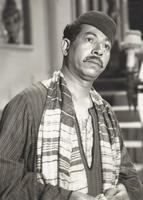
- Full name: Farid Shawqi Muhammad 'Abdu
- Born: 30 July 1920 — Cairo (Bulaq district), Egypt
- Died: 27 July 1998 — Cairo, Egypt
- Nicknames: “Beast of the Screen” (Waḥsh al-Shasha) and “King of al-Tarsu”
- Note: al-Tarsu refers to the inexpensive “cheap seats” section in old Egyptian cinemas, where mass audiences flocked.
- Family: Married more than once; father of Rania, Abeer, Nahed, Maha, and Mona.
Early Life and Education
- He grew up in Cairo’s popular Bulaq quarter, which rooted him in working-class life—a connection that later shaped his on-screen persona.
- He studied at the Higher Institute of Dramatic Arts and first appeared on stage before moving to cinema in the 1940s.
Career
- He began with villain roles, then transformed in the 1950s into a working-class champion who stood up for the downtrodden—an evolution that cemented his vast popularity in al-Tarsu cinema halls.
- Over more than five decades, he appeared in hundreds of films; he also wrote screenplays and produced through a company bearing his name, and later took on notable television work.
- He forged the template of the principled, strong hero, adeptly blending action with socially conscious melodrama (emotionally charged dramas centered on everyday struggles), and delivered humane performances praised by critics.
Selected Highlights
- Hamidu (1953)
- They Made Me a Criminal — Ja'aluni Mujriman (1954)
- Rasif No. 5 — Quay No. 5 (1956)
- al-Futuwwa — The Strongman (1957)
- Note: “Futuwwa” evokes the local “enforcer” figure who dominates an alley or marketplace.
- Futuwwat al-Hara — The Alley Enforcer (1957)
- Antar ibn Shaddad (1961)
- About the legendary pre-Islamic hero Antarah ibn Shaddad.
- 30 Days in Prison (1966)
- Word of Honor — Kalimat Sharaf (1973)
- The Water Carrier Is Dead — al-Saqqa Mat (1977)
- TV: al-Bakhil wa Ana — The Miser and I (1991)
- Stage: Shaari' Muhammad Ali — Mohamed Ali Street
- Mohamed Ali Street is a historic Cairo thoroughfare long associated with musicians, dancers, and show business.
Awards and Honors
- Affectionately known as the “Beast of the Screen” and “King of al-Tarsu,” reflecting his enduring influence and mass appeal.
Facts and Anecdotes
- One of Egyptian cinema’s most prolific stars and a key architect of the “popular hero” image.
- He decisively pushed action and socially oriented melodramas to the forefront of the box office for decades.
- He remained artistically present into his final years, balancing crowd-pleasing hits with profound, humanistic roles.
Films (304)





Series (1)

Progression
 Talaq So3Ad Hanem
(1948)
Talaq So3Ad Hanem
(1948)
 Laylat Al-3Id
(1949)
Laylat Al-3Id
(1949)
 Ayam Shababy
(1950)
Ayam Shababy
(1950)
 Asrar Al-Nas
(1951)
Asrar Al-Nas
(1951)
 Aamal
(1952)
Aamal
(1952)
 Ana Thanby Eh
(1953)
Ana Thanby Eh
(1953)
 Ga3Aloony Mogreman
(1954)
Ga3Aloony Mogreman
(1954)
 Raseef Nemra 5
(1956)
Raseef Nemra 5
(1956)
 Toggar Al-Mawt
(1957)
Toggar Al-Mawt
(1957)
 Abo 7Adied
(1958)
Abo 7Adied
(1958)
 Abo A7Mad
(1960)
Abo A7Mad
(1960)
 Al-Ragol Al-Tha3Lab
(1962)
Al-Ragol Al-Tha3Lab
(1962)
Professional network
Show common films with
Family tree



Gallery (3127)


Posters (16)


Screenwriter (26)


Characters (58)